03.07 Family Likes and Dislikes Writing Assignment Answers
Likes and Dislikes ESL Games, Activities and Worksheets
- Beginner (A1)
- Uncomplicated (A1-A2)
- Pre-intermediate (A2)
- Intermediate (B1)
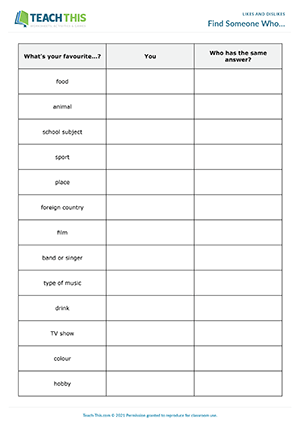
Discover Someone Who...
ESL Favourites Activity - Reading, Writing, Listening and Speaking - Beginner (A1) - 25 minutes
In this free favourites 'Find someone who' action, students write near their favourite things and and then ask and respond questions to find classmates who have the same favourites. Students begin by writing down their favourite things on the worksheet. Students and so go around the class asking and answering 'What's your favourite...?' questions to find classmates with the same answers. When students discover someone with the same answer, they write down that person'southward name. After, students written report back to the class on the names they wrote on their worksheet and say what their favourite things are.

Food Likes and Dislikes
ESL Likes and Dislikes Worksheet - Reading, Matching, Writing and Speaking Activeness - Beginner (A1) - 25 minutes
In this likes and dislikes worksheet, students learn and practice how to talk near food and potable preferences using beloved, like, dislike and detest. First, students match opinion verbs with pictures. Students then sort x nutrient and drink items, according to their preferences. Side by side, students work with a partner and take it in turns to enquire and answer questions near their likes and dislikes for the ten food and drink items using the case on the worksheet as a guide. After that, students read well-nigh food and potable that 4 people dear, similar, dislike or hate. Finally, students answer questions about the iv people's food and potable preferences.
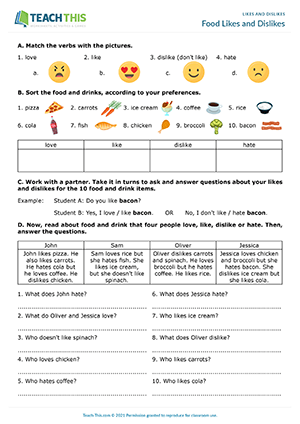
Interactive Version - In this likes and dislikes interactive worksheet, students piece of work through a diversity of exercises to learn how to use love, like, dislike and detest to express nutrient and drink preferences.
My Favourites
ESL Favourites Activity - Reading, Writing, Listening and Speaking - Beginner (A1) - 30 minutes
In this insightful favourites activity, students complete sentences well-nigh their favourite things and so ask questions to a partner to discover out about their favourites. Students showtime past completing sentences on the worksheet near their favourite things. In pairs, the students then practice asking and answering questions most their favourites. Afterwards, there is a form feedback session to find out about the students' favourite things.
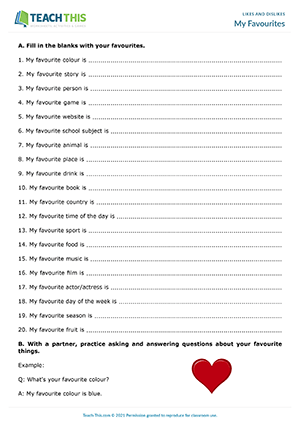
Interactive Version - In this favourites interactive worksheet, students write almost their favourite things and and then ask and answer questions with a partner.
Likes and Dislikes
ESL Do You Similar Action - Reading, Writing, Listening and Speaking - Elementary (A1-A2) - 35 minutes
In this free likes and dislikes activity, students ask 'Practice you like...?' questions and reply using degrees of feeling. Students begin by creating 4 'Do you like…?' questions of their ain at the bottom of the worksheet. Next, in pairs, students have it in turns to ask their partner the questions about likes and dislikes on their worksheet. Their partner replies using one of eight phrases from the worksheet to express their degree of feeling. The student so writes their partner'southward reply in sentence form in the space provided using the third-person singular, e.grand. 'Harry really likes drinking coffee'. When anybody has finished, students pair upwardly with someone who has the same worksheet and tell their partner the name of the person they interviewed. The two students then have turns asking and answering questions near the people using the tertiary-person singular. Finally, students study back to the class on their original partner'southward likes and dislikes.


Interactive Version - In this free likes and dislikes breakout room activity, students interview a partner almost their preferences in social club to practice 'Do you like...?' questions and degrees of feeling.
Match my Reply
ESL Favourites Game - Reading, Writing, Listening and Speaking Activity - Elementary (A1-A2) - thirty minutes
In this expressing favourites game, students ask and answer questions almost their favourite things and score points for matching favourites. To beginning, students respond questions on the worksheet nigh their favourite things and write down their answers. In pairs, students then accept information technology in turns to enquire the questions on their worksheet to their partner and notation down their answers, e.yard. 'What's your favourite particular of clothing?' Each time their partner gives a matching answer, the educatee scores a point. After that, students repeat the game with a new partner. The student with the highest score at the end of the game wins. Afterward, there is a class feedback session to detect out which two students are the nearly compatible and share the most favourite things.

My Favourite Person
ESL Favourite Person Worksheet - Drawing, Reading and Writing Activity - Elementary (A1-A2) - 25 minutes
In this engaging favourites worksheet, students draw and write almost their favourite person. Students brainstorm by drawing a picture of their favourite person in a box on the worksheet. This could be someone they know personally or someone famous. Next, students complete sentences about the person, including information nigh the person'due south proper name, age, job, appearance and their reasons for liking them. Subsequently, students have it in turns to show their motion-picture show and tell the class most their favourite person by reading their sentences aloud.

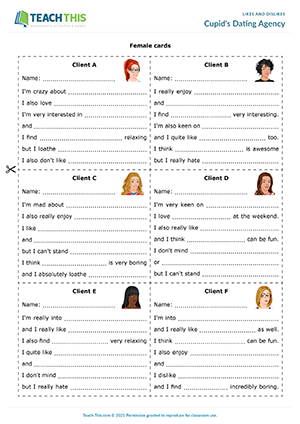
Cupid's Dating Agency
ESL Matching Preferences Activeness - Reading, Writing, Matching and Speaking - Pre-intermediate (A2) - xl minutes
In this free likes and dislikes action, students create dating profiles and then lucifer people together, according to their preferences. In pairs, students look at the pictures on the male or female person cards and fill in each profile with data most that person'south likes and dislikes. Each pair so joins upward with another pair that has an opposite set of cards. Next, students imagine that they run a dating agency called Cupid's. Their chore is to match the clients on the cards together for a engagement, co-ordinate to their preferences. The pairs and then take it in turns to read out each profile to the other pair. The students discuss the profiles and match the people together, co-ordinate to their likes and dislikes. Students should try to pair up all the men and women if possible and retrieve of reasons for their choices. Afterwards, each group tells the course nigh their virtually promising dates.
Do you similar...?
ESL Practise You Like Activity - Reading, Writing, Listening and Speaking - Pre-intermediate (A2) - 30 minutes
In this 'Do y'all like...?' questions action, students find out about a partner'south likes and dislikes. This activity covers various phrases for expressing preferences. In pairs, students take information technology in turns to enquire their partner 'Practice you similar ....?' questions from the prompts on the worksheet. Students besides enquire follow-up questions and make notes on their partner's answers. Afterwards, students tell the class about their partner's likes and dislikes, e.g. 'Tom loves cycling and he's really into playing team sports. Notwithstanding, he doesn't like doing housework, etc.'
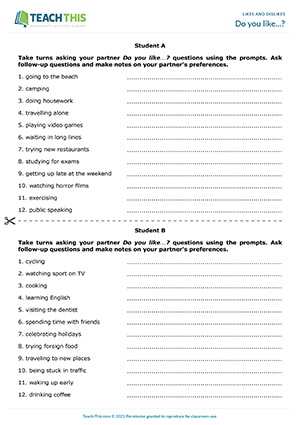
Interactive Version - This likes and dislikes interactive breakout room activity helps students to practice 'Do you lot like...?' questions and phrases that express preferences.
Expressing Preferences
ESL Preferences Worksheet - Reading, Writing, Listening and Speaking Activity - Pre-intermediate (A2) - 30 minutes
In this expressing preferences worksheet, students learn and practice various phrases for expressing likes, dislikes and indifference. After reviewing the language for expressing likes, dislikes and indifference, students consummate sentences on the worksheet with their preferences. In pairs, students then use the language from the beginning practise to make a dialogue expressing their likes, dislikes and indifferences. Finally, pairs nowadays their dialogues to the course.

Interactive Version - This expressing preferences interactive worksheet contains a variety of exercises to assist students acquire linguistic communication for expressing likes, dislikes and indifference.
Likes and Dislikes Board Game
ESL Expressing Preferences Board Game - Speaking Activity - Pre-intermediate (A2) - 30 minutes
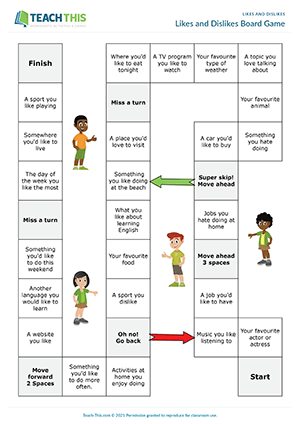
In this fun likes and dislikes board game, students talk about their preferences for 30 seconds. Students take it in turns to roll the dice and movement their counter along the lath. When a educatee lands on a square, they talk about the topic on the square for 30 seconds without stopping. If a student can't think of annihilation to say or stops talking earlier the thirty seconds are up, they go dorsum two squares. The first student to accomplish the finish wins the game.
Likes and Dislikes Survey
ESL Likes and Dislikes Activeness - Reading, Writing, Listening and Speaking - Pre-intermediate (A2) - 45 minutes
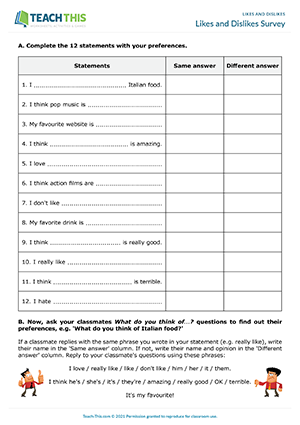
In this likes and dislikes questionnaire activeness, students conduct a survey about their preferences. To begin, students complete statements on the worksheet with their preferences. Students and then go around the grade and ask each other 'What do you think of...?' questions, e.g. 'What practice you lot think of Italian nutrient?' If a classmate replies with the aforementioned preference that the student has written in the argument, the student writes downwardly the person'due south name on the worksheet. If non, the student writes down the classmate'due south name and opinion. The first student to complete the worksheet with names is the winner. After, students write a short study about their findings, e.yard. 'Sophia and I really like Italian food'. 'I call back pop music is really good, but Ryan thinks information technology'south terrible, etc.' Students so read their reports to the grade.
Was information technology you?
ESL Likes and Dislikes Game - Writing, Listening and Speaking Activity - Pre-intermediate (A2) - 35 minutes
In this likes and dislikes game, students guess favourites, likes and dislikes of other students and use past simple yes/no questions to check their answers. In groups, students consummate ii slips of newspaper. On the first slip, students write their favourite word. On the 2d slip, they write a judgement most something they love, really like, dislike or hate. Next, students write the names of their group members on a worksheet. The group leader and then reads the favourite words and sentences and the group members write down who they think wrote each 1. Afterwards that, students go around their grouping asking a 'Did you write that your favourite word was...?' question to each grouping member in turn to check their guesses. Students answer 'Yes, I did' or 'No, I didn't' accordingly. Side by side, students go around the group once more asking a 'Was it you who wrote yous loved/really liked/didn't like/hated...?' question to each grouping member. Students respond 'Yes, it was' or 'No, it wasn't'. For each 'aye' response, students score i indicate. The student with the most points at the end of the game wins.

I Honey Charades
ESL Likes and Dislikes Game - Miming and Speaking Action - Intermediate (B1) - xxx minutes
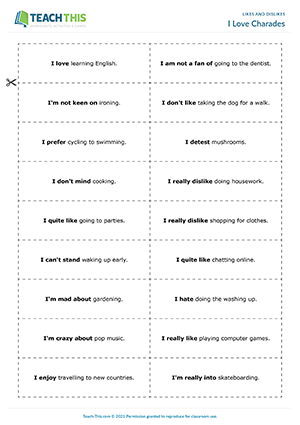
This fun likes and dislikes miming game tin can be used to practice a wide variety of phrases for expressing preferences. In the activity, students play a game of charades where they gauge sentences that each use a different phrase for expressing preference. A actor from Team A comes to the front end of the class and is given a judgement card. The thespian then has one infinitesimal to mime the judgement to their team. When the students say a word that is in the sentence, the player writes it on the board. If Team A manages to approximate the complete judgement inside one infinitesimal, they score two points. If not, the thespian continues their mime and both teams try to judge the sentence for one indicate. A actor from Team B then comes to the front of the class and then on. The team with the nigh points at the end of the game wins.
Finish Bugging Me!
ESL Expressions of Irritation Activity - Reading, Writing, Listening and Speaking - Intermediate (B1) - 30 minutes
In this dislikes action, students answer questions using common expressions of irritation. In pairs, students accept information technology in turns to inquire their partner the questions on the worksheet, eastward.g. 'Does it carp you when people stop at the bottom of escalators?' Their partner replies using expressions on the worksheet to prove their degree of irritation, e.1000. 'Yes, it gets on my fretfulness when people practice that'. The student asking the question then checks the appropriate box next to the question on the worksheet. This continues until all the questions accept been asked and answered. Afterwards, students study back to the grade on their partner's irritations.
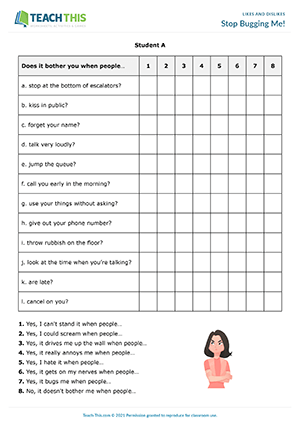
Interactive Version - Hither is an expressing dislikes breakout room activeness to assist students practice expressions of irritation.
Talk for a Minute
ESL Likes and Dislikes Game - Speaking Activity - Intermediate (B1) - 35 minutes
Hither is a fun preferences game to get your students talking nigh their likes and dislikes. In ii teams, students take it in turns to option upward a bill of fare and talk for one minute about the like or dislike topic on the menu. If the student manages to do this without stopping, they score a point for their team. If the student stops talking before their time is up, a student from the other team tin can challenge and go on for the rest of the infinitesimal. If the educatee from the challenging squad keeps talking for the remainder of the minute, they score the point for their team. The team with the most points at the stop of the game wins.
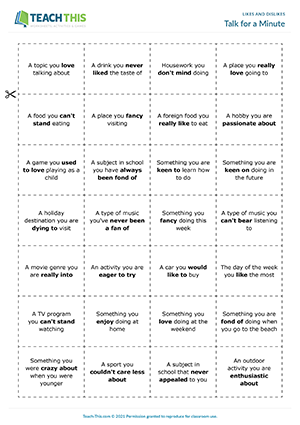
Who is information technology?
ESL Likes and Dislikes Game - Reading, Writing, Listening and Speaking Activity - Intermediate (B1) - 40 minutes
In this free likes and dislikes game, students complete descriptions about their likes, dislikes and interests and then guess who wrote other descriptions. Kickoff, students consummate sentences on the worksheet, describing their likes, dislikes and interests. Students and so write their assigned number at the acme of the worksheet without showing anyone. Next, collect in the worksheets and stick them up around the classroom. In pairs, students write the names of all the students in the form on a slice of newspaper. Pairs then walk around the classroom reading the numbered descriptions and deciding which student wrote each one. After, students accept information technology in turns to read out a description to the course. After a description has been read out, pairs say who they think wrote it and the reply is revealed. Pairs score i betoken for each correct guess. The pair with the near correct guesses wins the game.
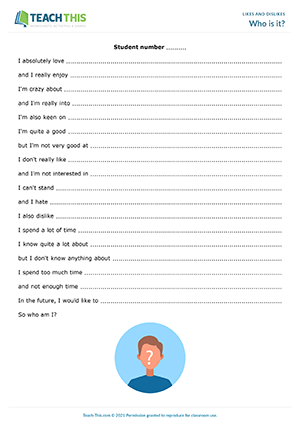
Source: https://www.teach-this.com/general-activities-worksheets/likes-dislikes

Post a Comment for "03.07 Family Likes and Dislikes Writing Assignment Answers"